
Head doctor
Dr. Kim Joon
Korean board-certified otolaryngologist (ENT) who has concentrated on rhinoplasty for more than 21 years and developed BAROKO's cartilage-particle technique.

Credentials
- BoardKorean board-certified otolaryngologist — specialist certificate No. 3510, issued 2 March 2011 by the Ministry of Health and Welfare
- DegreeDoctor of Medicine
- AcademicAdjunct professor, Sungkyunkwan University School of Medicine (Samsung Medical Center)
- Experience21+ years in rhinoplasty · 10,000+ rhinoplasty procedures
- SocietiesKorean Rhinologic Society · Korean Society of Otorhinolaryngology–Head and Neck Surgery · Korean Academy of Facial Plastic and Reconstructive Surgery — head of the rhinoplasty research division
- ResearchPresented a histologic study of e-PTFE (Gore-Tex) in the nose at Rhinology World, Philadelphia, 2009
- Innovation연입코 (Yeonipko) trademark registered in Korea, No. 40-2443737 (2025) · patent application filed for the cartilage-particle processing and injection method, KR 10-2024-0085896 (2024)
- TeachingLectures at Korean academic meetings; has trained visiting overseas surgeons in the BAROKO technique
How he works
Consultations at BAROKO are one-to-one with Dr. Kim. Early in his career he presented a histologic study of e-PTFE (Gore-Tex) in the nose; today his practice centres on reconstructing the nose with the patient's own cartilage — septum, ear or rib — prepared as moulded particles.
Because he is an otolaryngologist, the airway is part of every plan: the septum, nasal valve and turbinates are assessed alongside the shape you want.

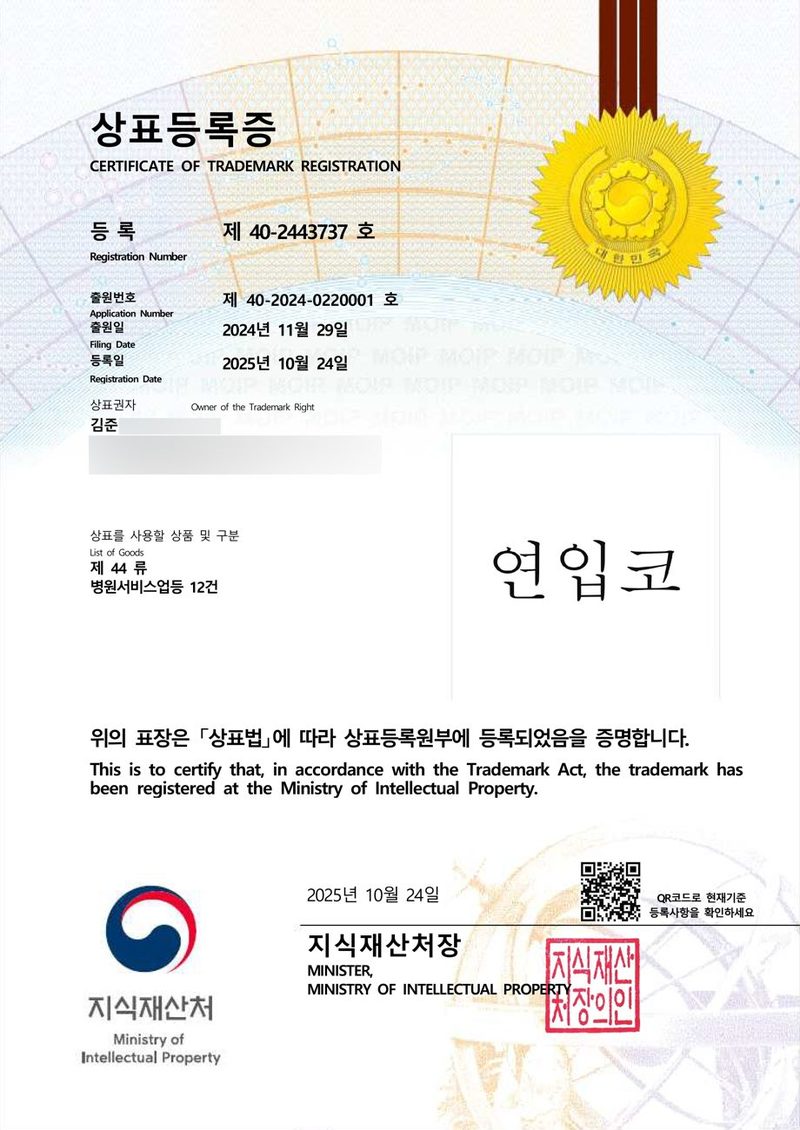
연입코 · Yeonipko
A registered name for a specific method
"연입코" combines the Korean words for cartilage particle and nose. The name was registered as a trademark by the Korean Intellectual Property Office on 24 October 2025 (No. 40-2443737). Separately, a patent application covering the cartilage-particle processing and injection method was filed on 1 July 2024 (application No. 10-2024-0085896, inventor Kim Joon).
A patent application is not a granted patent; the status is reported here as filed.