
Signature technique · 연입코
Cartilage-particle rhinoplasty
Your own cartilage, minced and moulded, in place of a silicone implant — the technique Dr. Kim Joon has refined at BAROKO and registered as a trademark in Korea.
Who it is for
- You want a higher bridge or a refined tip but would rather not have silicone or Gore-Tex
- You have had inflammation, contracture or displacement with an implant and need a revision
- You want a soft natural line — or a more defined one — made from your own tissue
- You also have a deviated septum or a blocked side and want both fixed in one operation
How the operation works
- Consultation and planning. Dr. Kim examines the nose, reviews photos and, when needed, an in-clinic CT scan, then chooses the cartilage source.
- Harvest. Cartilage is taken from the septum, the ear or a rib.
- Micronisation. The cartilage is minced into micro-sized particles and refined.
- Consolidation. Particles are bound with autologous blood components to improve handling and support survival of the graft.
- Moulding. A custom mould is prepared and the particles are packed into it, giving a graft the shape of a bridge implant — but made of your own tissue.
- Placement and closure. The graft is inserted along the bridge and tip, the skin is closed and a splint and dressing are applied.
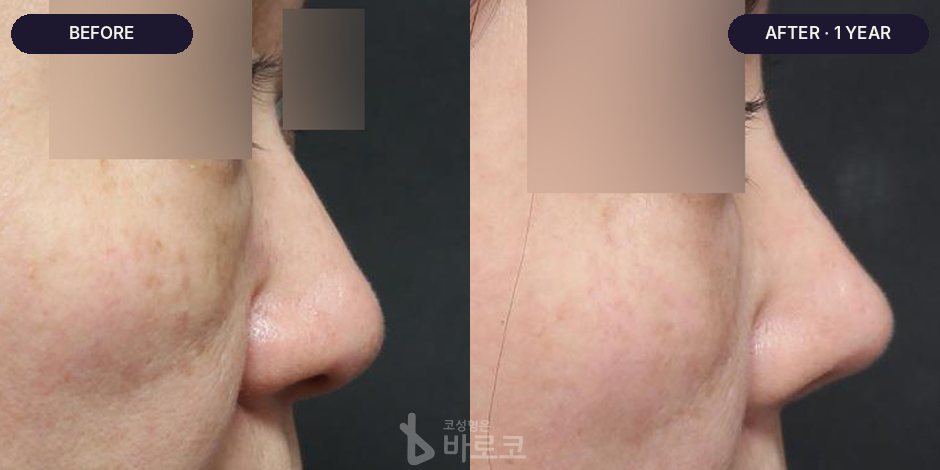
Particles versus implants and solid cartilage
| Silicone / Gore-Tex implant | Solid cartilage strip | Cartilage particles | |
|---|---|---|---|
| Material | Synthetic | Your own | Your own |
| Main concern | Infection, contracture, displacement, visible edges | Warping over time | Possible partial volume change |
| Shaping | Pre-carved | Limited by the piece | Moulded to any bridge/tip shape |
| Revision use | Often the cause | Yes | Yes — common |
Comparison reflects the clinic's surgical rationale; your individual risks are explained at consultation.
Natural or defined — both are possible
A common worry about implant-free rhinoplasty is that it only gives a modest change. The clinic's view is that, depending on the cartilage used, particle grafts can reach bridge heights comparable to silicone, so both a soft natural line and a more defined profile are achievable. The limit is your skin envelope and the cartilage available — Dr. Kim will show you a realistic target.
Recovery in brief
Expect a splint for about a week, bruising and swelling that settle mostly over the first two to three weeks, and gradual refinement over months. Hyperbaric oxygen sessions are available at the clinic as part of aftercare. See the recovery guide.
Cost
The clinic lists primary rhinoplasty from ₩3,500,000 and revision from ₩5,000,000. Full price list.